
The Promise and the Trap of AI for SMBs
AI has moved from buzzword to business reality. For small and mid-sized businesses, it promises productivity gains, faster decisions, and the ability to compete at enterprise scale. But most AI projects fail to deliver on that promise.
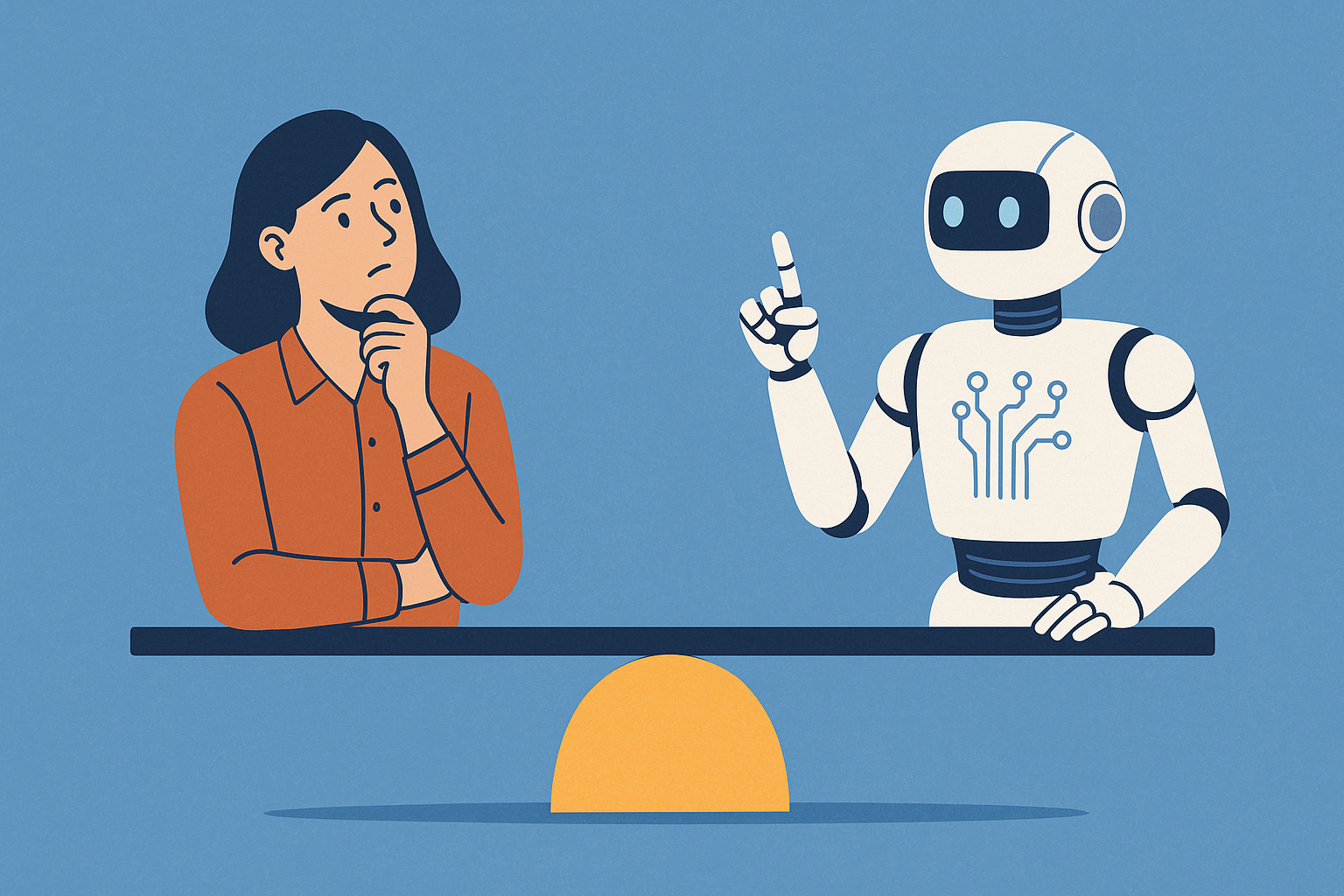
Why? Because they skip the most important design question: Where should the human stop, and where should the machine start?
People are great at reasoning and bad at tedium. Machines are great at repetition and getting better at reasoning every year. The goal isn’t to automate everything—it’s to find the optimum point between human judgment and machine consistency, and build from there.
This is the foundation of a useful AI solution.
Step 1: Map the Human–Machine Boundary
Every AI project starts with a workflow – a real business process where time or money is lost to repetition, inconsistency, or delayed decisions.
Before writing a line of code or signing a software contract, map the process end to end. For each step, ask two questions:
- Does this step require judgment or empathy? (Keep it with the human.)
- Does this step involve repetition, calculation, or structured data? (Delegate it to the machine.)
The most effective solutions are not “fully automated.” They’re balanced systems where:
- Humans focus on context, relationships, and high-level reasoning – and retain ultimate control of the outcome.
- AI handles data-heavy, rule-based, or time-consuming tasks.
Example:
In a quoting process, a person might still decide on final pricing based on client relationship and perceived value, but AI can instantly analyze historical quotes, detect pricing anomalies, and generate draft responses.
Step 2: Design for Ongoing Management
AI isn’t a project – it’s a system that must be managed. Once deployed, models and data pipelines drift. Workflows evolve. The humans using the system change their habits.
This is where many SMB AI pilots collapse – they assume success at launch means success forever.
From day one, bake management into the design:
- Version control: Track models, data transformations, and prompt versions like software code.
- Monitoring and testing: Create alerts for unexpected behavior or performance drops.
- Retraining cycles: Plan for when and how the AI will learn from new data.
- Ownership: Assign both a business owner (responsible for ROI) and a technical owner (responsible for reliability).
By managing AI as a living system, you maintain trust, stability, and measurable results.
Step 3: Measure ROI – Before and After
You can’t improve what you don’t measure. Before building, define success in concrete terms:
- How much faster should the process be?
- How much more accurate or consistent?
- What revenue or margin impact do we expect?
Then collect baseline metrics before AI is introduced. After implementation, track the same metrics to measure change.
Examples of measurable outcomes:
- Quote turnaround time reduced by 40%
- Manual data entry cut by 75%
- Customer response rate improved by 15%
These before-and-after metrics turn AI from a technology story into a business growth story. They’re also critical for justifying further investment or expansion.
The Payoff: A Compounding System
When AI is designed at the optimal point between human and machine, managed over time, and measured consistently, it becomes more than a tool—it becomes a compounding system:
- Each workflow improvement increases the accuracy of the next.
- Each new dataset strengthens your models.
- Each measurement informs smarter decision-making.
The result isn’t just efficiency – it’s structural advantage.
Build What’s Useful, Not What’s Trendy
For SMBs, the real value of AI doesn’t come from chasing the latest tools. It comes from designing systems where:
- People stay focused on reasoning, creativity, and relationships.
- Machines handle repetition and support better decisions.
- ROI is tracked and improved systematically over time.
That’s the formula for AI that works in the real world – where business growth compounds, trust deepens, and technology becomes a reliable partner rather than a constant experiment.